
L'onboarding IT : au-delà des illusions, une réalité complexe et exigeante.
Publié le Feb 9, 2026
7 minutes
Découvrez les 3 challenges de l'onboarding IT et comment optimiser votre logistique.

Êtes-vous déjà arrivé dans une nouvelle entreprise, prêt à relever vos défis, pour réaliser qu’il vous manque l’essentiel pour travailler ? Vous n'êtes pas seul. Selon une étude de la Vlerick Business School, 57 % des salariés ne disposent pas de tous les outils et accès nécessaires à leur arrivée. L'onboarding informatique, souvent négligé par les outils SIRH, est pourtant le pivot de la performance.
Alors que la guerre des talents fait rage, les entreprises rivalisent d’ingéniosité pour attirer les meilleurs profils. Pourtant, l'onboarding IT reste trop souvent le parent pauvre du processus d'intégration.
Les conséquences d'un processus chaotique sont désastreuses, tant pour la productivité que pour la marque employeur :
- Commerciaux sans CRM : impossibilité de suivre la formation interne ou de traiter les leads.
- Accès réseaux inexistants : incapacité de consulter les documents stratégiques du département.
- Emails et canaux de communication : boîte mail active, mais absence des listes de distribution et des canaux Slack/Teams essentiels.
- Shadow IT et matériel personnel : utilisation de ressources personnelles par dépit, créant des failles de sécurité majeures.
Selon Deloitte, 82 % des entreprises ne se sentent pas prêtes le jour de l’arrivée d’un nouveau collaborateur. Pourquoi ce constat persiste-t-il, même avec une solution SIRH en place ?
1. Premier challenge : une gestion des ressources éclatée dans l’entreprise
Le premier obstacle à un onboarding IT fluide est la fragmentation de la gestion actifs entreprise. L’informatique ne détient plus toutes les clés :
- La DSI : gère le parc informatique, l'Active Directory et les accès réseaux.
- La finance : administre souvent les logiciels de comptabilité et de notes de frais.
- Le commerce & marketing : gèrent en direct le CRM (Salesforce), Linkedin Sales Navigator, et les outils de Marketing Automation.
- Les Services Généraux : s'occupent des badges d'accès physiques, des places de parking et de la flotte de véhicules.
Cette décentralisation transforme la gestion logistique collaborateur en un véritable casse-tête où l'information circule mal.
2. Deuxième challenge : la personnalisation des ressources selon le profil
Un bon onboarding IT n'est pas standard. Chaque collaborateur doit recevoir des ressources matérielles et logicielles spécifiques à son rôle, en plus du socle commun (email, Teams, ordinateur portable) :
- Les développeurs : clavier spécifique, double écran, accès Github/Gitlab, Docker, accès SSH serveur.
- Les commerciaux : smartphone, CRM, licence Sales Nav, véhicule de fonction, logiciel de notes de frais.
- Le marketing : suite Adobe Creative Cloud, Facebook Business Manager, accès aux solutions de veille.
Sans une matrice précise des profils, l'IT navigue à vue et multiplie les tâches chronophages pour ajuster les accès après l'arrivée.
3. Troisième challenge : une coordination complexe entre RH, Managers et IT
Pour obtenir une "photo" complète des besoins d'un nouvel arrivant, trois acteurs doivent se synchroniser parfaitement :
- Les RH : formalisent l’entrée (contrat, administratif) mais n'ont pas toujours le détail technique.
- Le manager : c'est le seul à savoir précisément de quels outils son collaborateur aura besoin pour réussir.
- Les responsables de ressources : qu'ils soient internes (DSI) ou externes (prestataires SaaS), ils doivent recevoir l'information suffisamment tôt pour anticiper la préparation.

L'absence d'un outil centralisant ces flux force les équipes à utiliser des emails, des messages Teams ou à se croiser à la machine à café, augmentant les risques d'oubli et d'erreurs de provisionnement.
4. Pyla : La solution pour unifier votre logistique collaborateur
Pour relever ces défis, il est impératif d'utiliser un logiciel onboarding IT qui comble le fossé entre le SIRH et l'exécution technique.
Pyla est une plateforme B2B conçue pour coordonner l'ensemble des parties prenantes. En s'interconnectant à votre SIRH, Pyla permet de :
- Centraliser les demandes de matériel collaborateur et d'accès logiciels.
- Automatiser les notifications vers les différents administrateurs (IT, Finance, Services Généraux).
- Gérer les mouvements 360° : onboarding, offboarding IT et gestion mobilité employé.
Ne laissez plus l'illusion d'un processus maîtrisé nuire à votre croissance. Structurer votre logistique informatique est un investissement rentable pour votre productivité et votre sécurité.
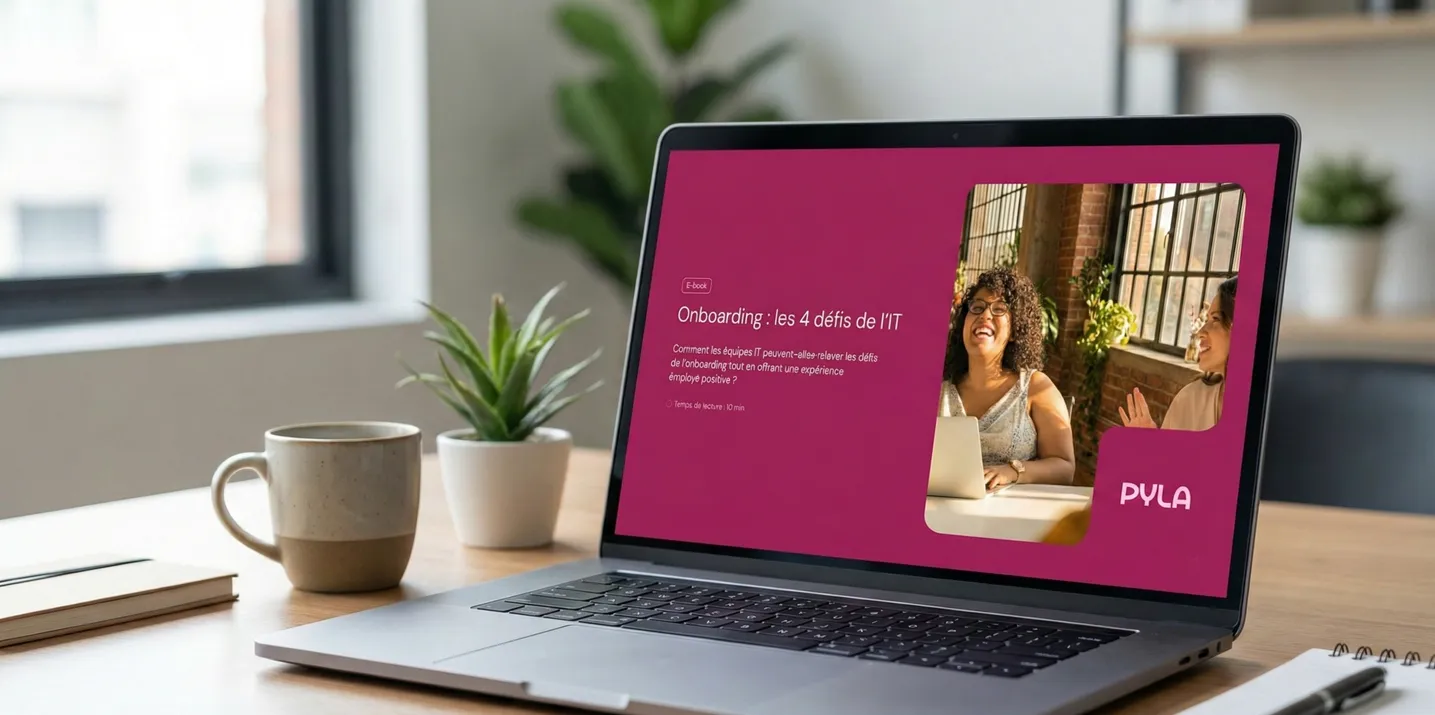
E-book : les 4 défis IT de l'onboarding.
Pourquoi l’onboarding IT joue un rôle clé dans l’expérience collaborateur ? Quelles pistes pour le rendre plus performant ?
Questions en lien
Pourquoi le SIRH ne suffit-il pas pour gérer l'Onboarding IT ?
Le SIRH est conçu pour la gestion administrative et contractuelle. Il ne possède pas la granularité nécessaire pour gérer les 20+ ressources matérielles et logicielles techniques et ne peut pas coordonner les administrateurs métiers décentralisés.
Quel est le risque de laisser un manager gérer ses propres accès logiciels ?
Le risque est double : financier (licences inutilisées ou en doublon) et sécuritaire (Shadow IT). Sans supervision de la DSI via un logiciel Onboarding IT, l'entreprise perd le contrôle sur ses données et ses dépenses.
Comment l'Onboarding IT impacte-t-il la rétention des talents ?
Un onboarding réussi augmente la rétention de 58 %. À l'inverse, un collaborateur sans outils le premier jour se sent dévalorisé, ce qui nuit gravement à votre Marque Employeur dès la phase d'essai.
Peut-on automatiser l'Onboarding pour les prestataires externes ?
Oui. Bien que gérés hors SIRH, les prestataires peuvent être intégrés dans Pyla pour bénéficier du même niveau de rigueur logistique et de sécurité que les salariés internes.